Dialing It In — A Gears Lesson with Coach Erik
This was my second Gears lesson with Erik Barzeski at Golf Evolution in Erie, and I didn’t leave with a fix. I left with information. Feels come and go, but I now have a clearer read on what my swing is actually doing and what to work on to dial it in, and that read is something I can take to an empty range and practice against.
There’s never a single fix in golf. It’s a process, and that’s the part I love, both about the game and about chasing a goal like 5 by 50 that gets measured in years. You never really arrive. You get a little closer, find the next thing, and go back to work.
Erik and I have been working together about eighteen months. This was my fourth or fifth time in person and my second under the Gears cameras. We had a little over two hours, and we spent the bulk of it on the full swing before moving to chipping and folding pitching in at the end.
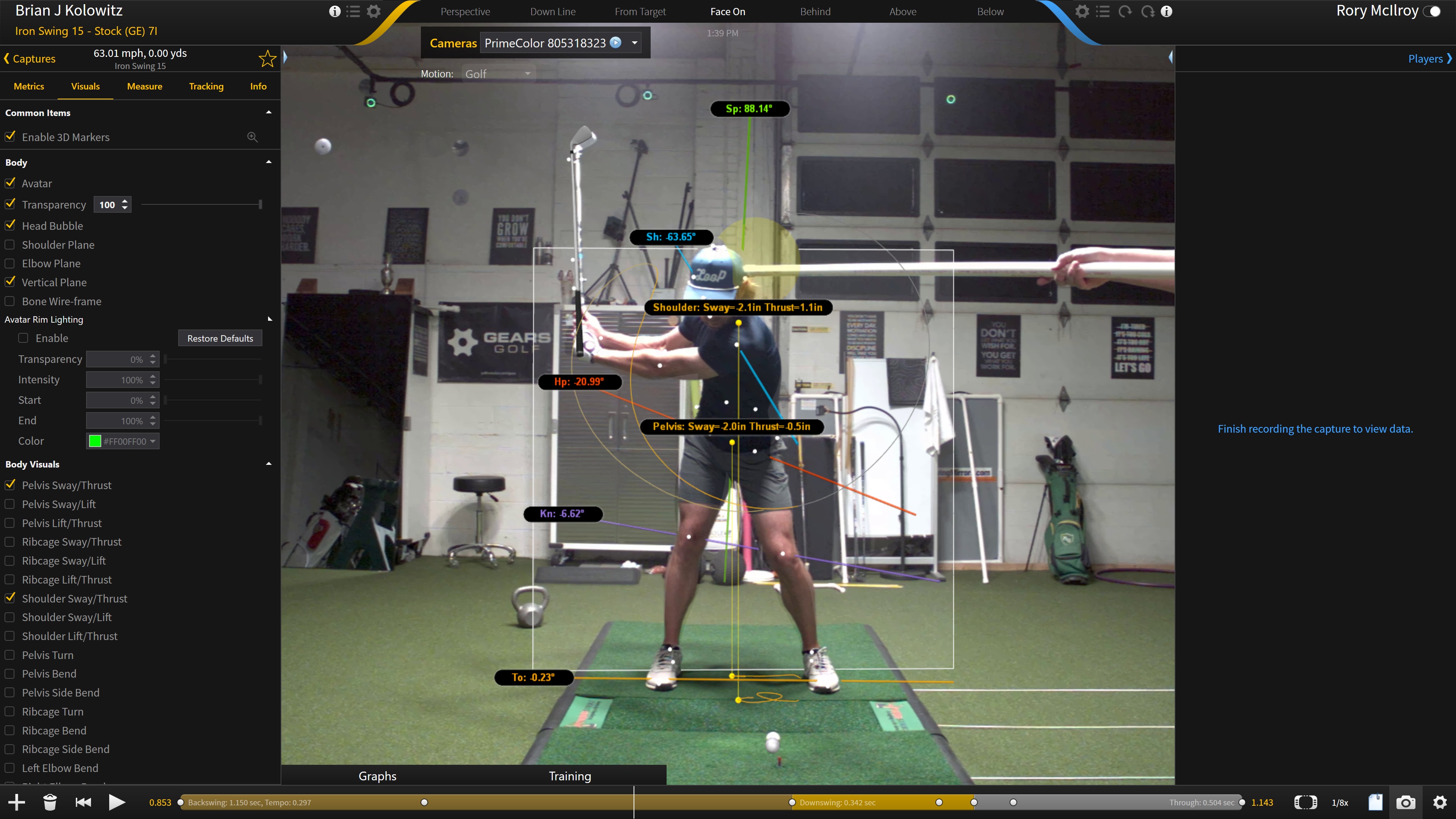
Top of the backswing, captured. The overlay isn’t decoration. Every number is a position we can talk about.
What the Cameras See
Gears (@gears.sports) is a ring of high-speed cameras, twelve to fourteen of them, set up around the bay. They track markers on your body and the club and calculate a full 3D model of the swing in real time, accurate to a fraction of a millimeter, hundreds of frames per swing. What you get back is an avatar you can rotate to any angle, slow to a crawl, and stack against another swing. There were noticeably more cameras and more rigging this time than on my first Gears session, which meant more angles to work from.
 The same swing as a model you can spin around. No camera angle to argue with.
The other thing worth saying about how Erik works is that it’s outcome-based, not rep-based. He doesn’t need a hundred swings to read what’s going on. Ten is plenty for someone who knows what he’s looking at, and the capture gives him all of it from every side at once.
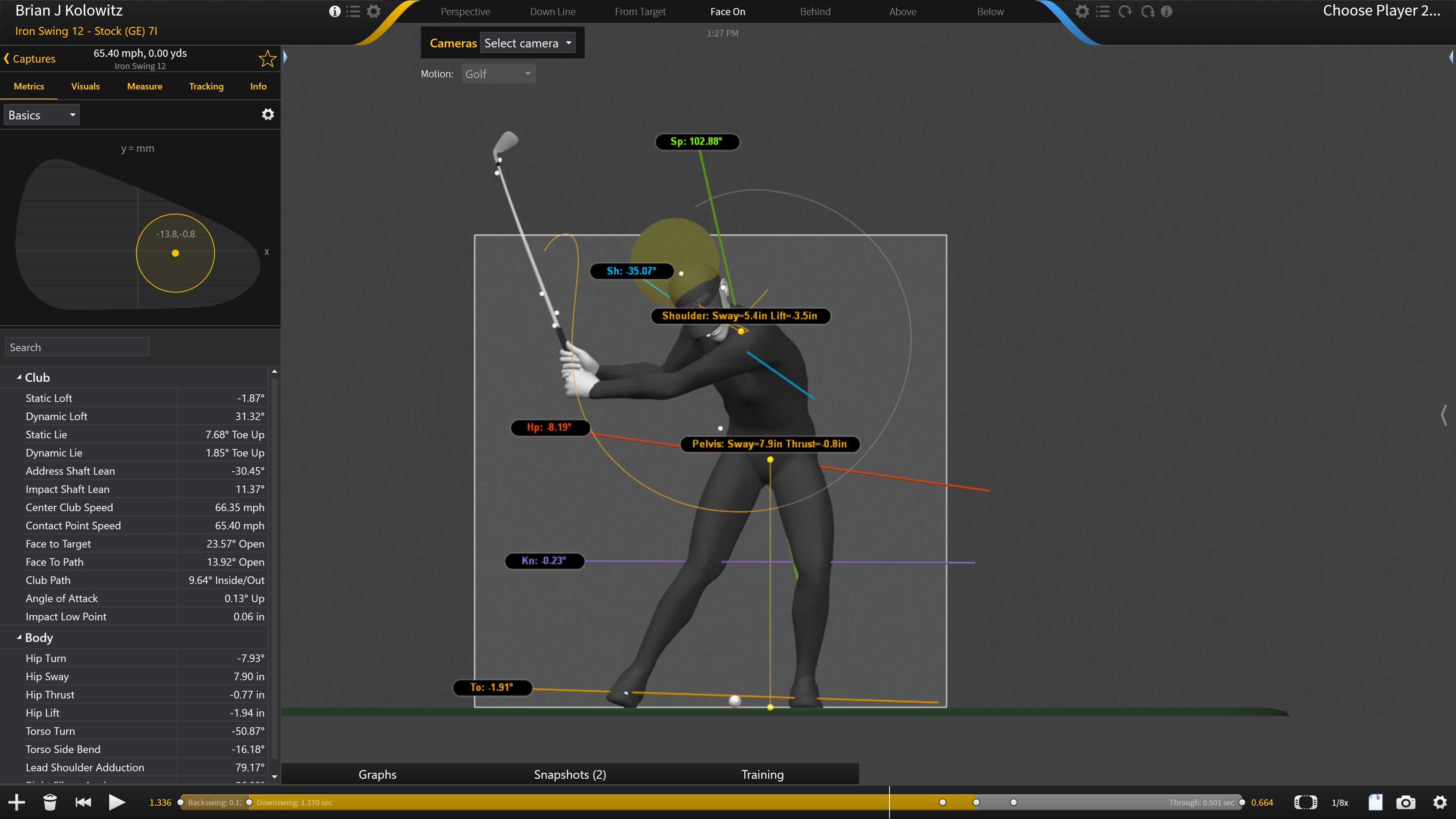
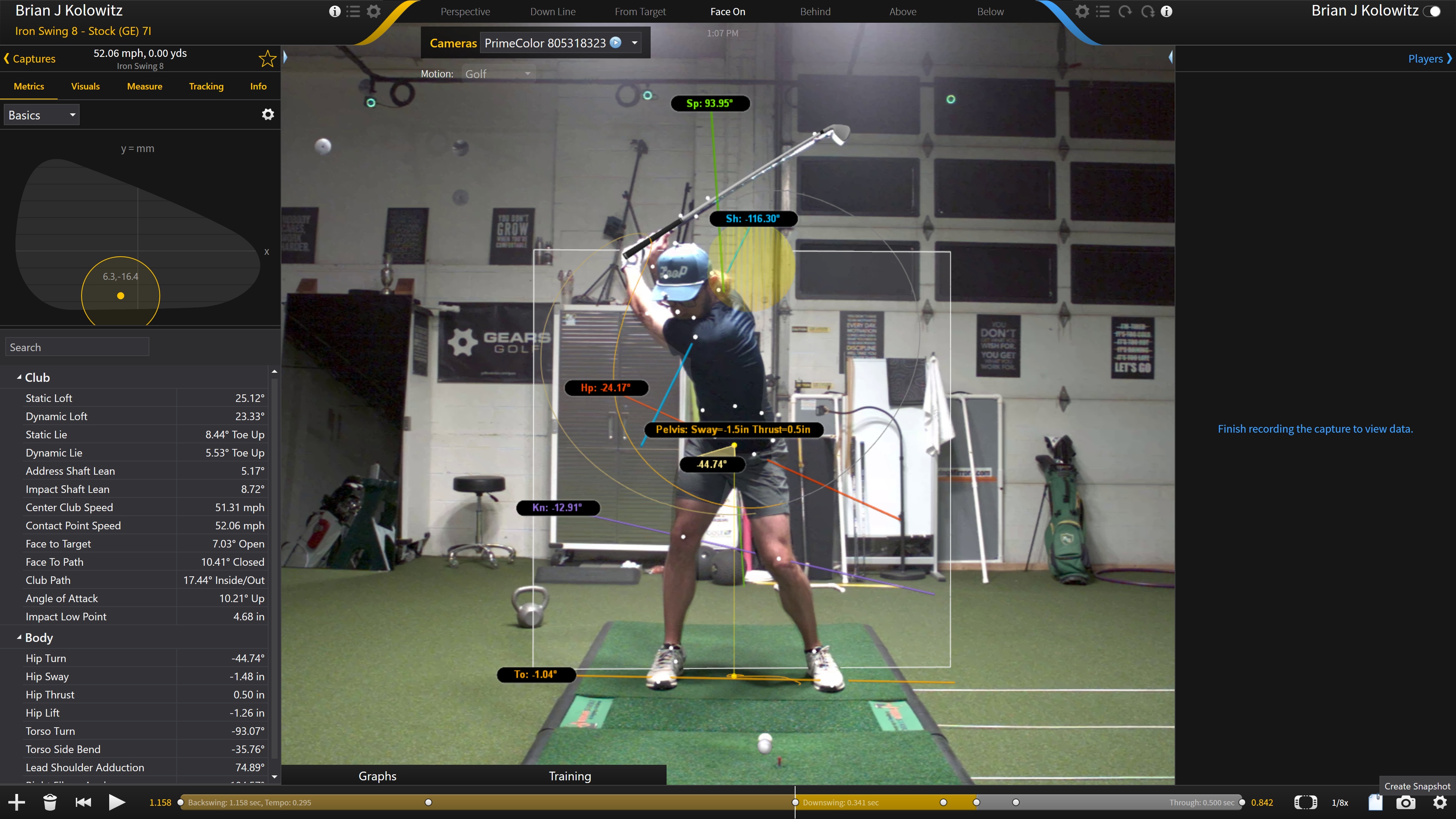 The same swing reduced to numbers. Club path, angle of attack, hip turn, torso turn, all of it.
Swing Captures
Two of the captures at full speed, one from each angle. The down-the-line view is the 3D model on its own, with no video behind it. The face-on view tracks that model against the camera footage.

Down the line, the 3D model on its own.

Face on, the model tracked against the camera footage.
More of the session’s captures are in the playlist.

A few of the captures from the session.
Getting Forward the Wrong Way
Erik found it quickly. In the backswing I tilted a little forward, toward the target, instead of staying stacked. Then in the downswing my head led the way and I got forward, onto my front side but not the ideal way to get there. It’s the kind of thing you can feel is off without being able to name it, which is exactly what Gears is good at solving.
He gave me two corrections, with the instruction to work them one at a time and not stack them. The first is in the backswing: feel my chest stacked over my trail leg, light on the chest, pointed slightly below horizontal, with my shoulders turning around ninety degrees but staying stacked over my pelvis instead of tilting. The second is the transition: lead with the hip. I shift my lead hip toward the target to start down, rather than leading with the knee, which drops me, or the shoulders, which tilts the spine the wrong way.
The clip below is one of the exaggerated reps, chest stacked over my trail leg and pointed down at the ground, running the backswing fix well past where it should sit. The better news came at impact, where my weight shift and tilt both improved. My tilt at impact measured 100 degrees, against a tour average of 102.

One of the exaggerated backswing reps.
The feel I floated for that hip move was the right side of my pelvis pointing angularly forward and down. I’m not sure I’ve actually found it yet. That’s mirror work for me this week. In the bay, Erik put a strip of tape on the mirror, and the drill was keeping my head behind that line as my pelvis moved toward the target. Do that and the side bend shows up on its own, without me trying to manufacture it.
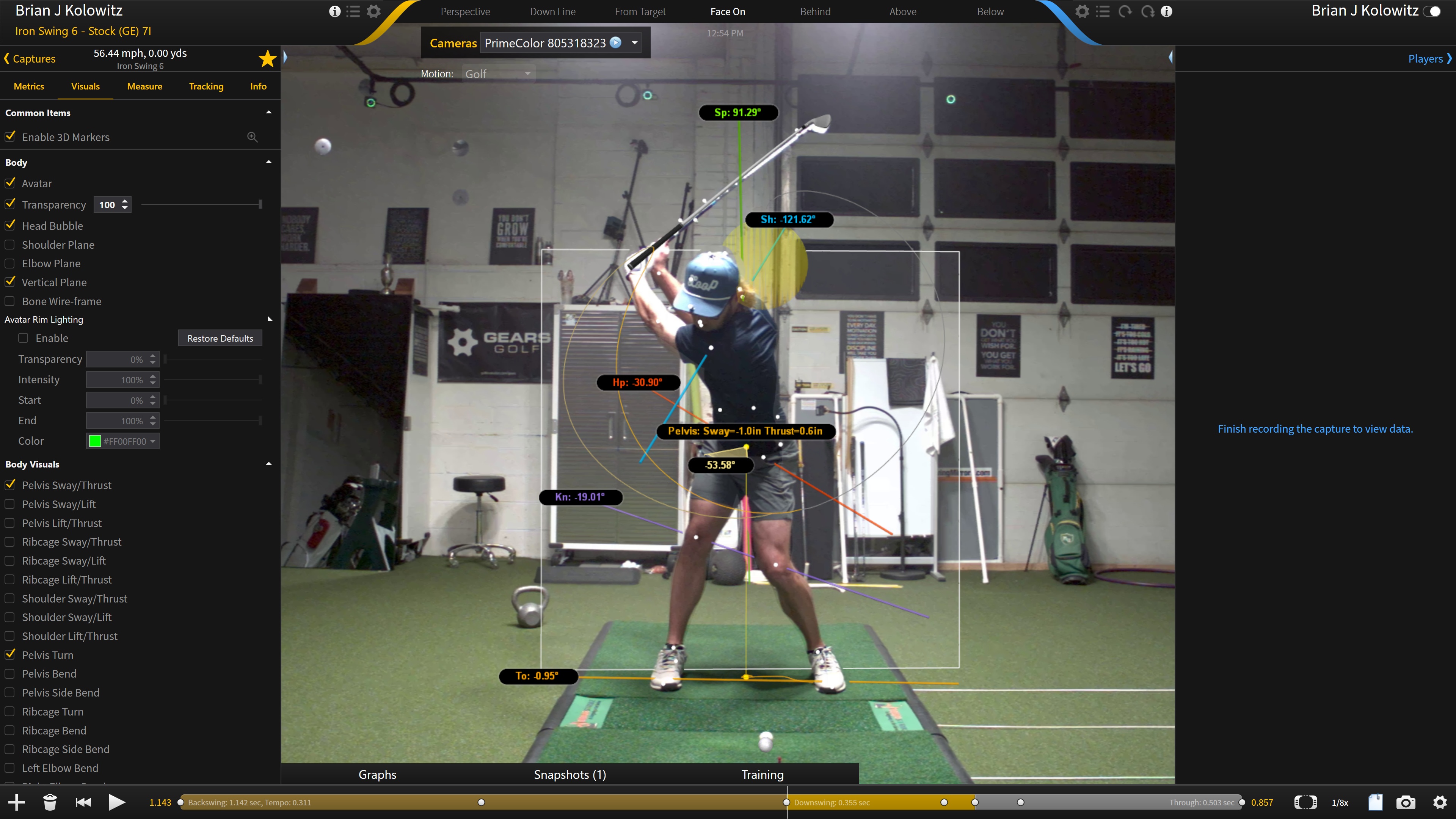 Transition, where the head starts leading. This is the moment we kept rewinding to.
At one point Erik pulled up a capture of Rory McIlroy’s swing as a benchmark. Seeing a tour model at the same point in the swing makes the difference obvious in a way that no description ever could.
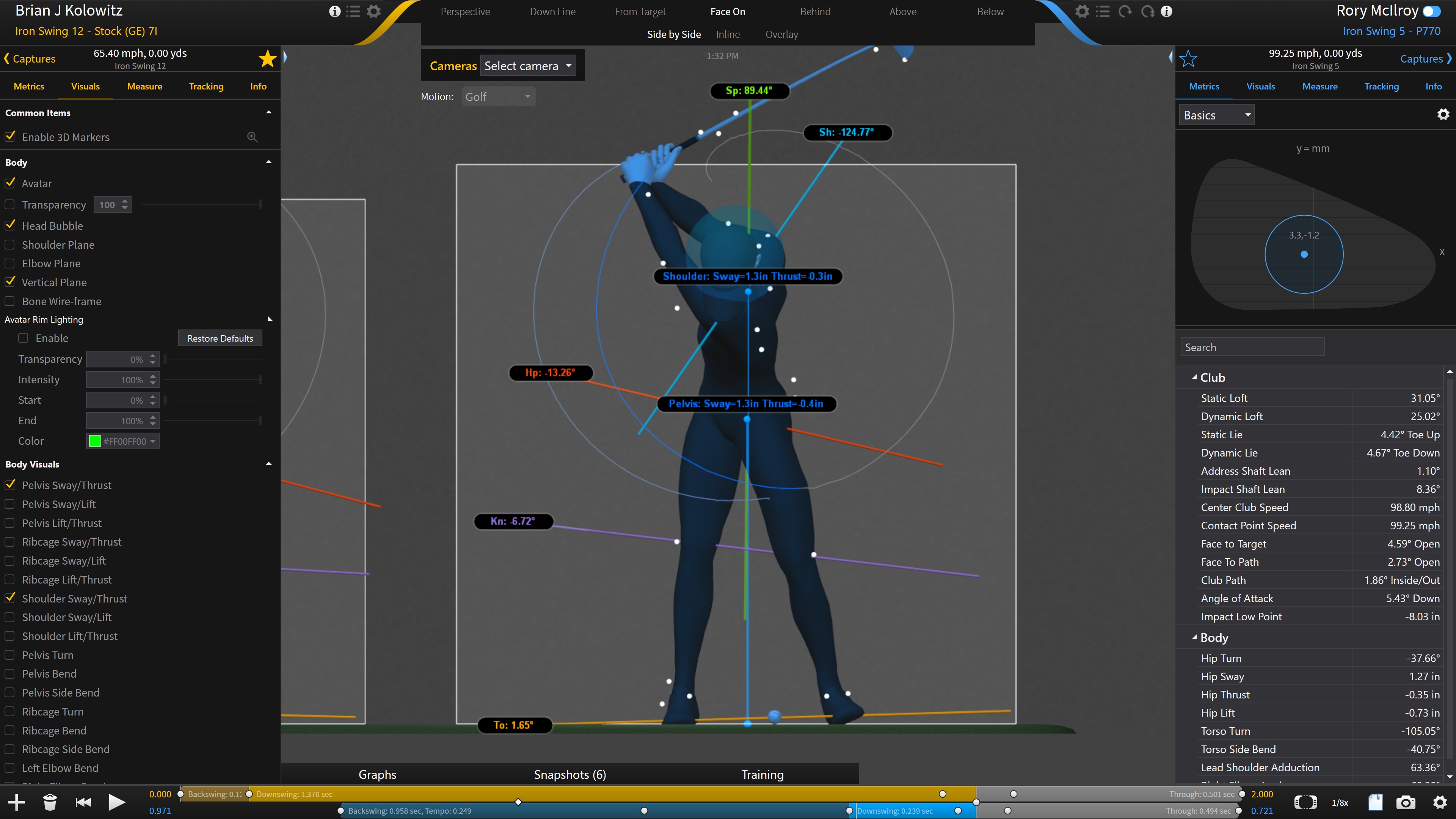 Rory’s swing at the top, the model Erik had me measure against.
It’s one thing to be told how to do something. It’s another thing to be told and shown.
Chipping: Let the Lower Body Do Nothing
We spent close to an hour on chipping, and the whole premise is that the lower body does nothing. No knee bend, no hip rotation. The stance is narrow, three to six inches, and I choke down and lift my heel to get closer to the ball.
The motion is an upper-body tilt, not a rotation. I tilt my shoulders toward the target to take the club back, let gravity bring it down, and then stand up through it so my chest finishes facing the target. The self-checks are simple enough to use alone: if the club whips up above my hips on the way back, I’m rotating with my body instead of tilting, and my lead arm has to stay extended rather than collapsing into my chest.
Then I did the thing I came for without knowing I’d come for it. I made a chip check on command. It caught the bounce, took a hop, and grabbed. I’ve hit good chips before, but by accident, and I could never repeat them. This one I meant.
I’ve never really done that before, not intentionally at least. This one was intentional, and that felt good.
I wouldn’t say I’ve got it. It didn’t feel mastered. What I got was proof that the technique works in my hands, and a reference for the good one. When I practice it alone now, I can tell whether I’m repeating it or just getting lucky again, which I never could before.
Pitching: The Part I Don’t Have Yet
Pitching builds on the same idea with a few changes. Wider stance, more vertical, more wrist, and instead of steering the clubhead with my hands I let it release through like a pendulum. You manage the flight with the face and the handle. Open the face and it starts the ball right, so you lower the handle to bring the start line back left. Raise the handle and you’ve effectively stepped closer to the ball; lower it and you’ve stepped farther away.
The take-home drill is to pitch one-handed, right hand only, until I can feel the club release on its own without my doing anything to it.
I understand the intention now. I’m a long way from being able to do it with a score on the line, and I’m not going to pretend otherwise. That one’s still ahead of me.
Tighter Spirals
The theme running under all of it was unlearning. The way I got forward in the full swing, the hand manipulation in the short game. A lot of the two hours was Erik pulling old patterns out of the motion rather than adding anything new.
Spine angle is something we’ve circled before. I keep coming back to it. What’s different now is that I get there faster, from a higher baseline, because the arm structure and the path have improved since the last time we worked on it. Erik put it well.
We’re circling, but the spirals are getting tighter, and we’re getting closer.
A Tool for Talking About the Swing
The thing I keep landing on about Gears is that it’s as much a way to talk about the swing as a way to measure it. A swing happens in three dimensions and in time, and most of coaching is one person trying to hand another person a feel using words, which are slow and lossy for the job. Gears skips most of that translation. We watch the same model, Erik exaggerates the over-done and under-done versions until I can see the edges of the move, and I dial in toward the middle.
I’d have to do a thousand online lessons to understand what I get out of one Gears session.
I’ll keep the feedback loop going between visits through Skillest, where I film reps and send them to Erik. But the in-person capture is where the information actually comes from. The plan from here is one thing at a time, no stacking:
- Full swing: chest stacked over the trail leg, pointed slightly below horizontal.
- Transition: shift the pelvis toward the target.
- Chipping: tilt forward, let it fall, stand up through it.
- Pitching: the face-and-handle adjustments.
The pitch under pressure is the next loop. I’ll get there the way the chip started checking, with reps and a clear picture of what I’m working toward. That’s the process, and I’m in no hurry to skip it.
Golf Evolution — Erie, PA. May 22, 2026. Second Gears session with Erik Barzeski. ~2 hours 15 minutes across the full swing, chipping, and pitching.