This One's For You, Dad — 84 at Mystic Rock
Standing on a tee box at Mystic Rock, somewhere on the front nine, I looked across the fairway and saw a point off in the distance my dad loved to visit. He passed recently. I hadn’t expected to see anything that reminded me of him today. I wasn’t ready for it.
I told him this one’s for you and piped one nearly 300 yards down the center of the fairway.
That’s the round. Everything else is just scorecard.
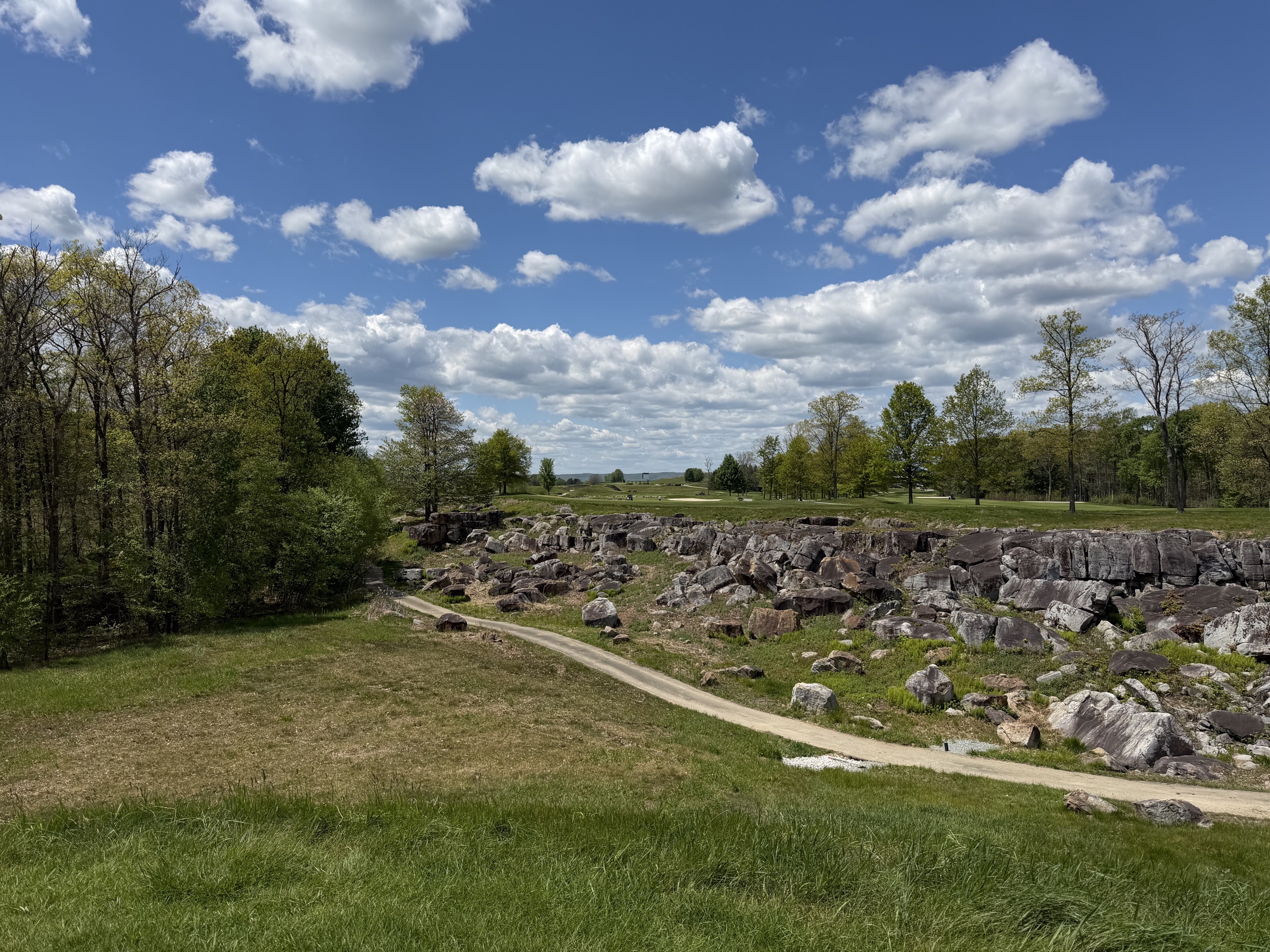
A Pete Dye signature — Pennsylvania bedrock that refused to move, left where it was found.
How I Got Here
I played Mystic Rock today through a WPGA Play Day — one of the Western Pennsylvania Golf Association’s standing programs that opens up access to private clubs and bucket-list venues across the region. If you’re a Pittsburgh-area golfer and you’re not paying attention to the Play Day calendar, you’re missing out. This is how regular golfers get on irregular courses.
Mystic Rock has been on my radar for years. It’s one of those courses you read about, see in Golf Digest’s “Best Public” rankings, watch flashes of on old PGA Tour broadcasts — and somehow never quite get around to playing. Today was the day.
I didn’t have a clear mental picture of what to expect. Maybe that’s the best way to show up.
Mystic Rock at Nemacolin
The Course Pete Dye Blasted Out of a Mountain
A little context, because Mystic Rock has a story that earns the telling.
Pete Dye is one of the handful of architects you can’t talk about modern golf without invoking. Harbour Town. TPC Sawgrass. Kiawah’s Ocean Course. Whistling Straits. The guy didn’t design courses so much as he staged confrontations between golfers and the land. Bold bunkering, deceptive distances, oval greens, rectangular sand, railroad ties when he felt like it. His courses don’t ask you to play well. They ask you to commit.
Mystic Rock opened in 1995, commissioned by Joseph A. Hardy III — the 84 Lumber founder — as the centerpiece of his Nemacolin mountain retreat in the Laurel Highlands. Dye had to earn this one. The course was literally blasted out of the mountainside. The boulders you see scattered through the rough on multiple holes? Those aren’t decorative. That’s Pennsylvania bedrock that refused to move. Every water hazard is bulkheaded with stacked stone. The whole place feels like it’s holding its ground — because in a real sense, it is.
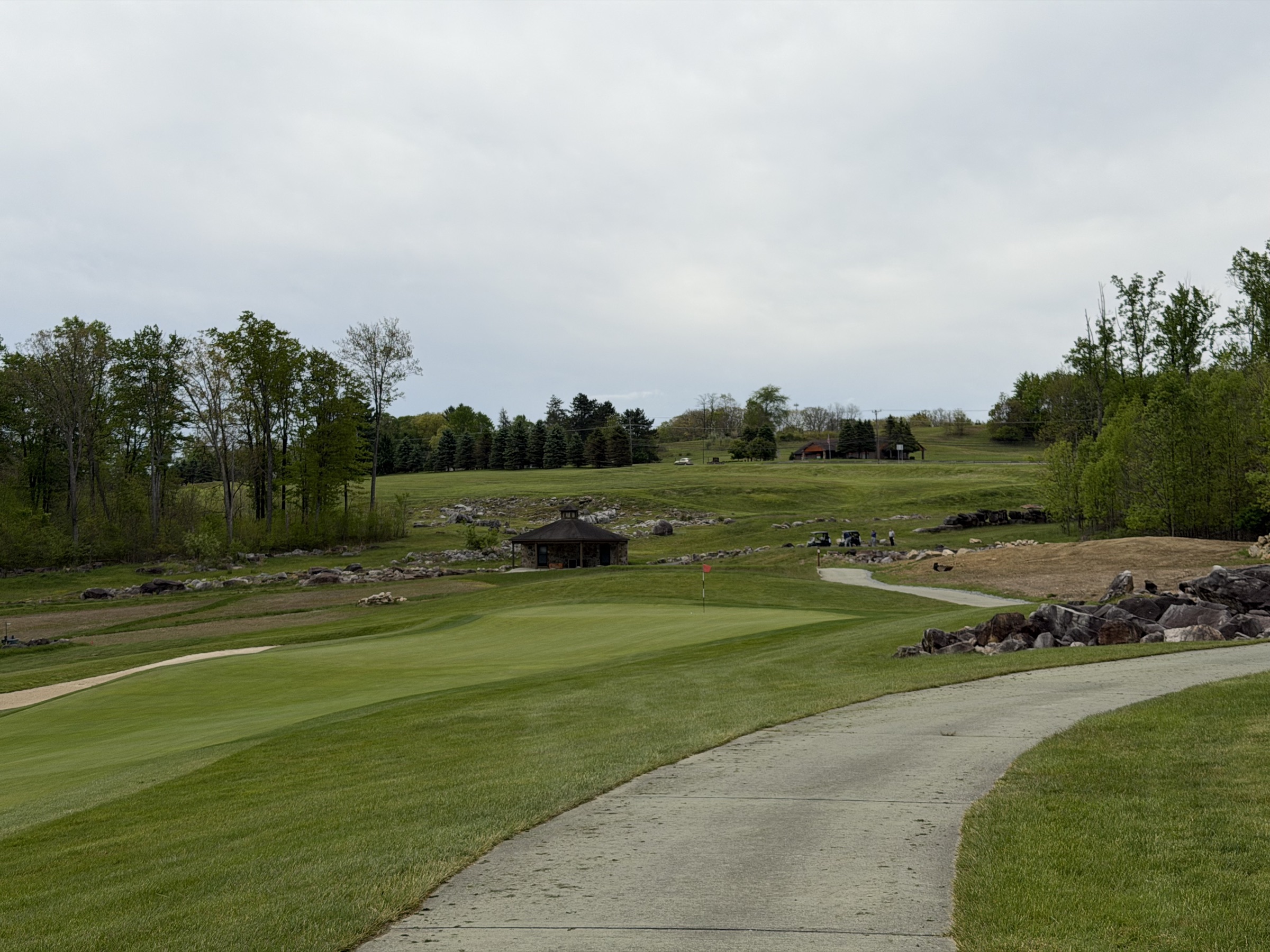 Stacked stone, bedrock, and an approach that gives away nothing. Every hazard here is part of the architecture.
The course hosted four editions of the PGA Tour’s 84 Lumber Classic from 2003 to 2006. Hardy took the Tour pros’ feedback seriously and brought Dye back to lengthen holes and refine the routing. Then in 2021, golf architect Tim Liddy completed an extensive bunker renovation with direct input from Dye himself, just before Dye passed in 2020. Mystic Rock today is a living, breathing tribute to one of the game’s defining minds. Golf Digest has had it on the America’s 100 Greatest Public Courses list every cycle since 2009.
You feel all of this when you play it. The course doesn’t tell you it’s important. It just is.
What Playing It Actually Feels Like
We played the white tees, so the course wasn’t stretched to its full 7,526-yard championship length. Don’t let that fool you. The rating and slope from the whites (71.4 / 135) tell you what you need to know: this place asks questions regardless of which tees you choose.
The terrain is what gets you first. You’re on top of a mountain, and the elevation does real work on the routing. Holes open up into panoramic vistas. Then they tighten back into corridors of rock and trees. The wind was up today — hard at times — but came in gusts that died down if you waited it out. On a meaner day, this course would chew you up.
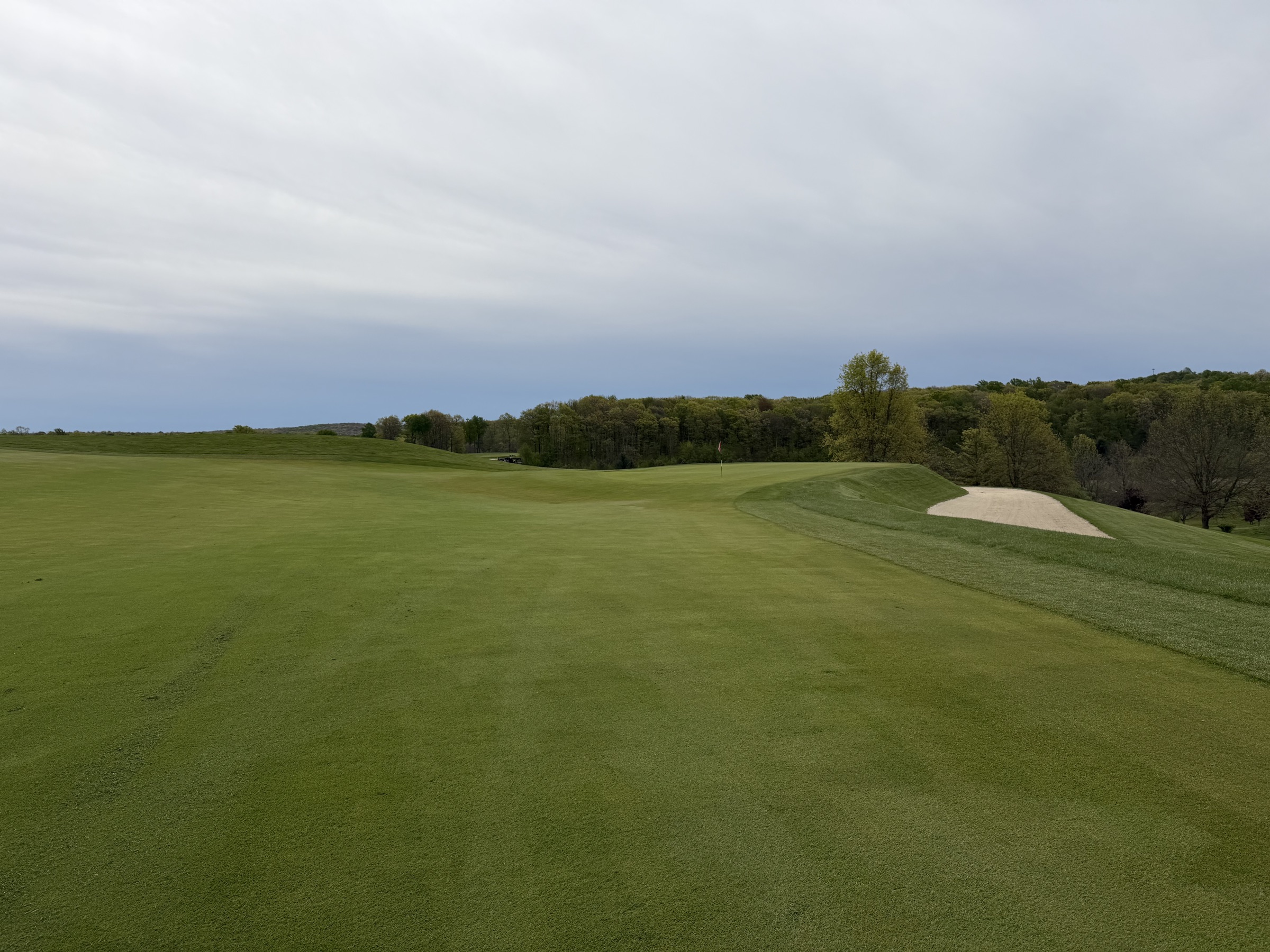 Uphill, into the wind, with a bunker complex on the right exactly where you want to bail. Standard Dye.
The greens are pure Pete Dye. Fast, true, and shaped with enough subtle architecture that the wrong angle of approach turns a birdie putt into a survival exercise. The closing stretch — 16, 17, 18 — is reportedly Dye’s favorite finish of any course he ever designed. A gambling par-5, a long par-3 over water, and a demanding par-4 uphill to the house. I can see why he loved it. By the time you get there, the course has built up real momentum, and those three holes deliver on the promise.
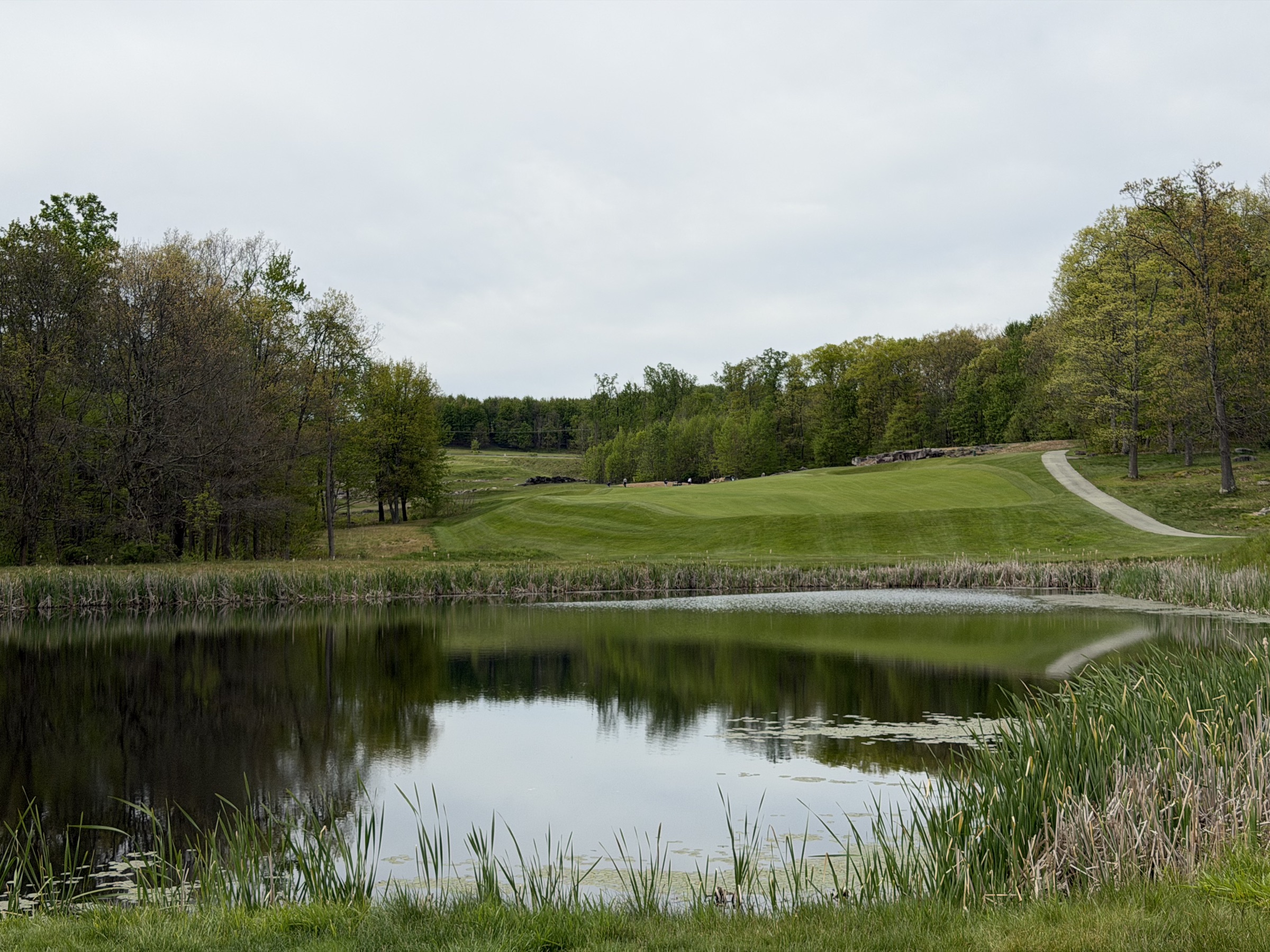 Water doesn’t just sit on this property — it works. Every carry is a decision.
The Round
I shot 84 gross. Off a 14.7 index, that’s roughly a 67 net — and the handicap dropped to 14.0 by the next morning. (Latest from the performance page.)
Scorecard
+12| Nine | Par | Score | +/− |
|---|---|---|---|
| Front | 36 | 38 | +2 |
| Back | 36 | 46 | +10 |
| Total | 72 | 84 | +12 |
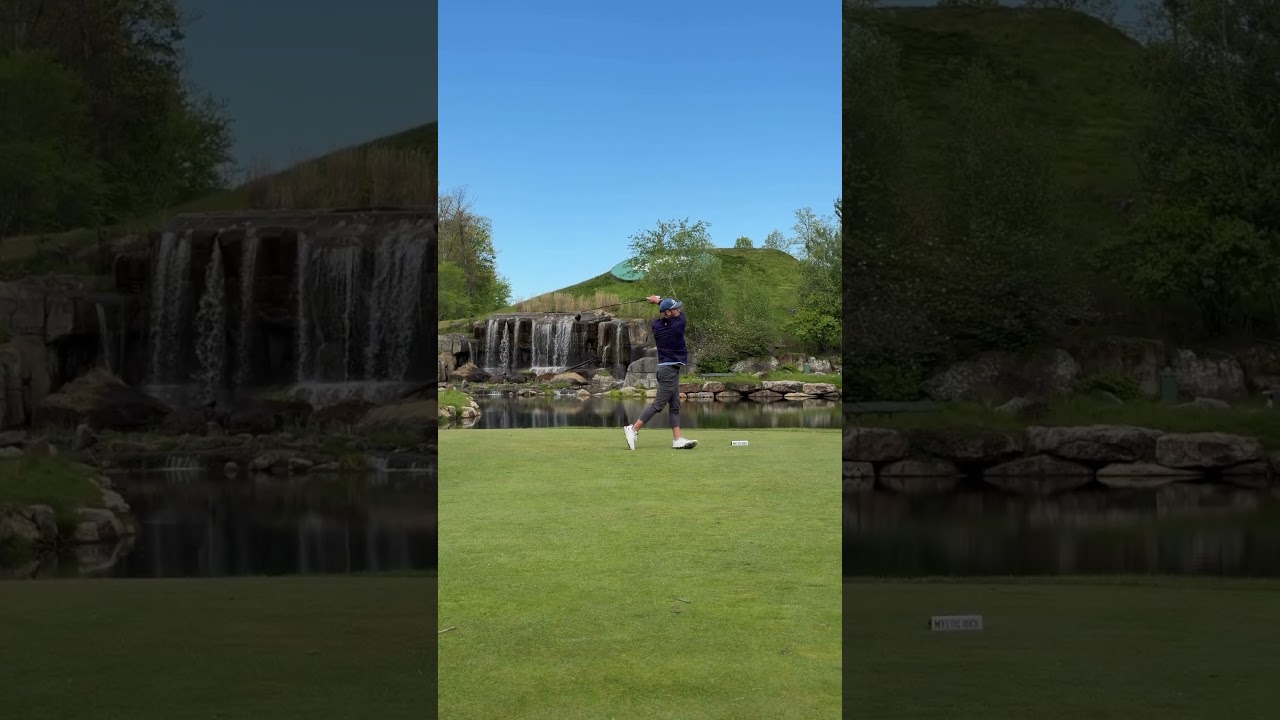
The front nine was one of the best stretches of golf I’ve played in months. After the moment with my dad, something settled. I birdied hole 4. Eagled hole 5 — a par-5, the one I’d hit the drive on. Birdie-eagle, back-to-back, sitting two-under through that stretch of a Pete Dye top-100 course.
The drive that set up the eagle — waterfall in the background, exactly the kind of frame Mystic Rock gives you for free:
And the putt that fell:
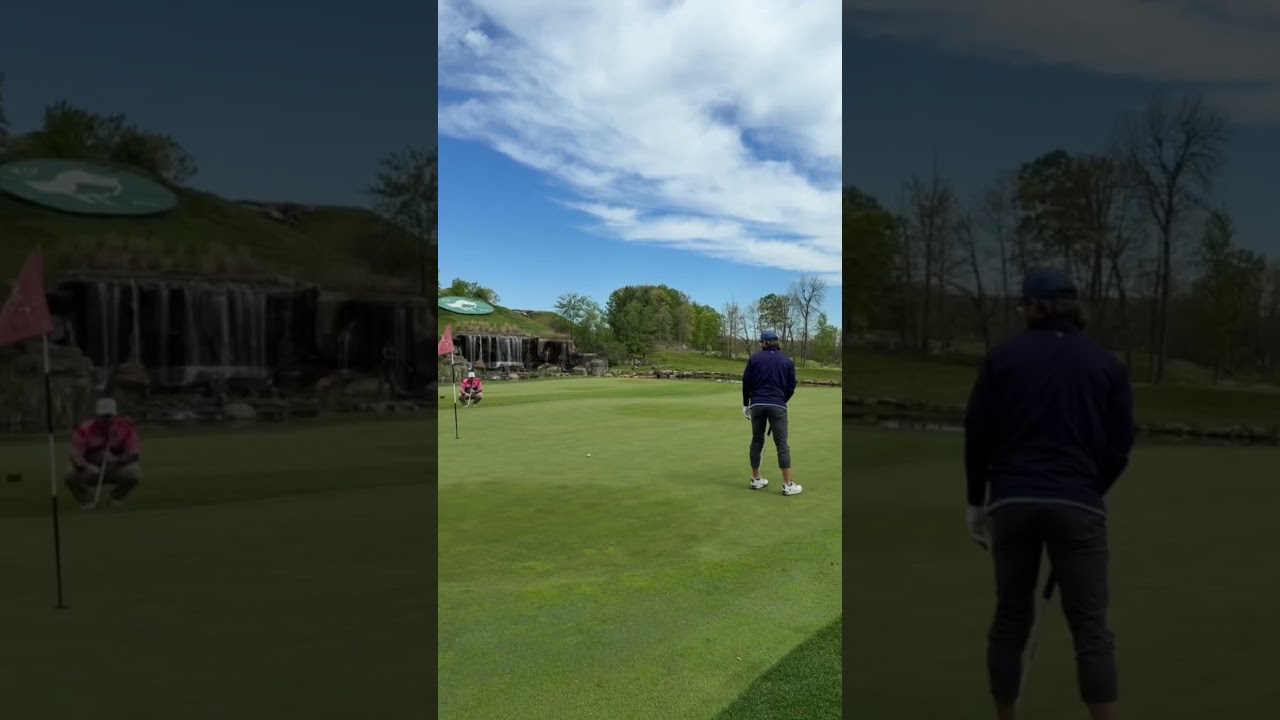
I gave a couple back with bogeys after the hot start, but I made the turn at 38. Two over. Locked in.
Another tee shot from the round, because at Mystic Rock the tee boxes are where the architecture talks loudest:

The back nine asked harder questions. Mystic Rock’s inward half is where the architecture really shows its teeth — more elevation change, trickier green complexes, and the psychological weight of having played well and wanting to protect it. I posted a 46 coming home. Not a collapse, but a fight.
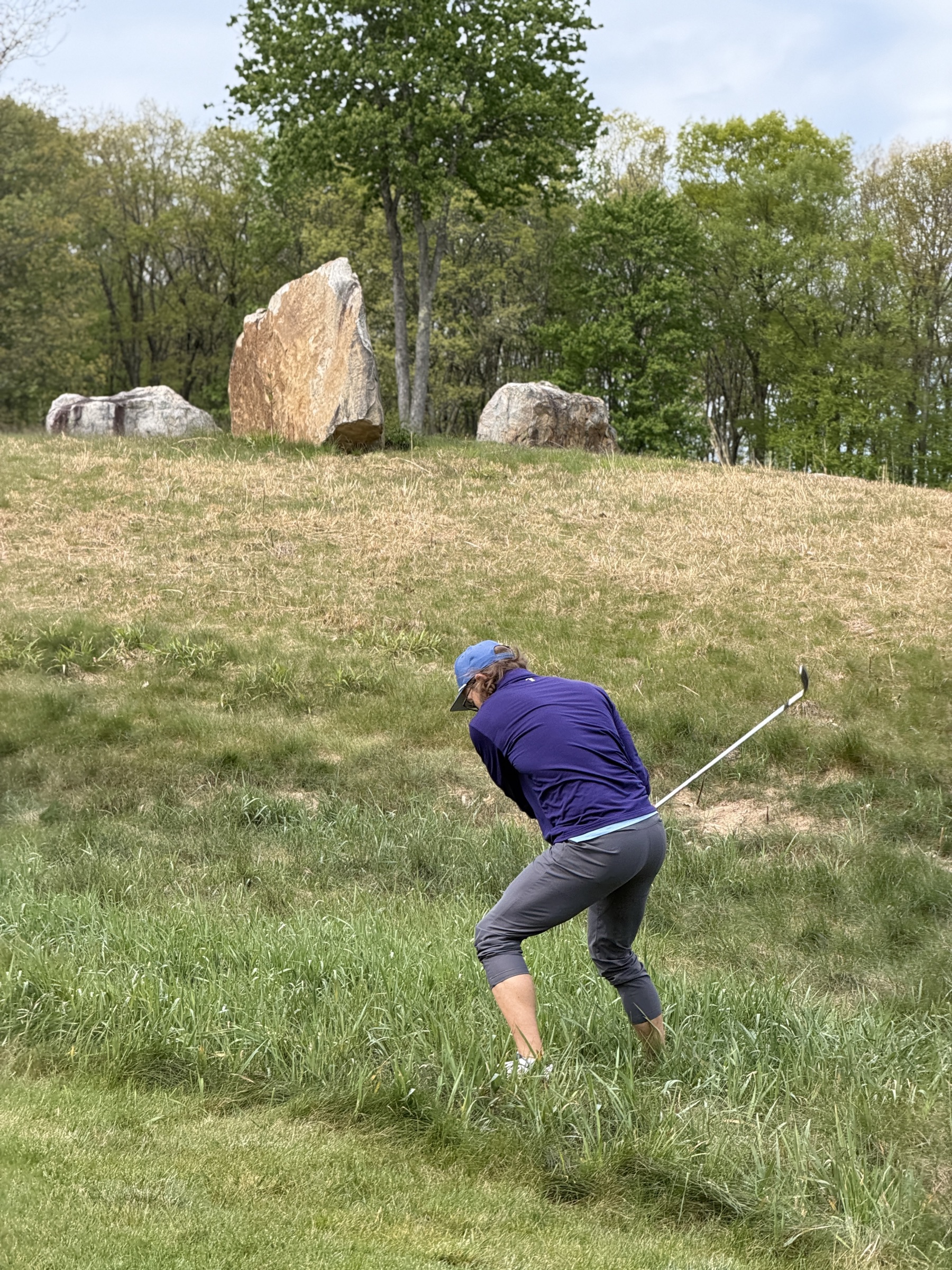 The back nine had moments. Out of the rough with the boulders watching — Mystic Rock doesn’t let you get comfortable.
84 gross. 67 net. A round I’ll remember.
But the eagle isn’t even what I’ll remember most.
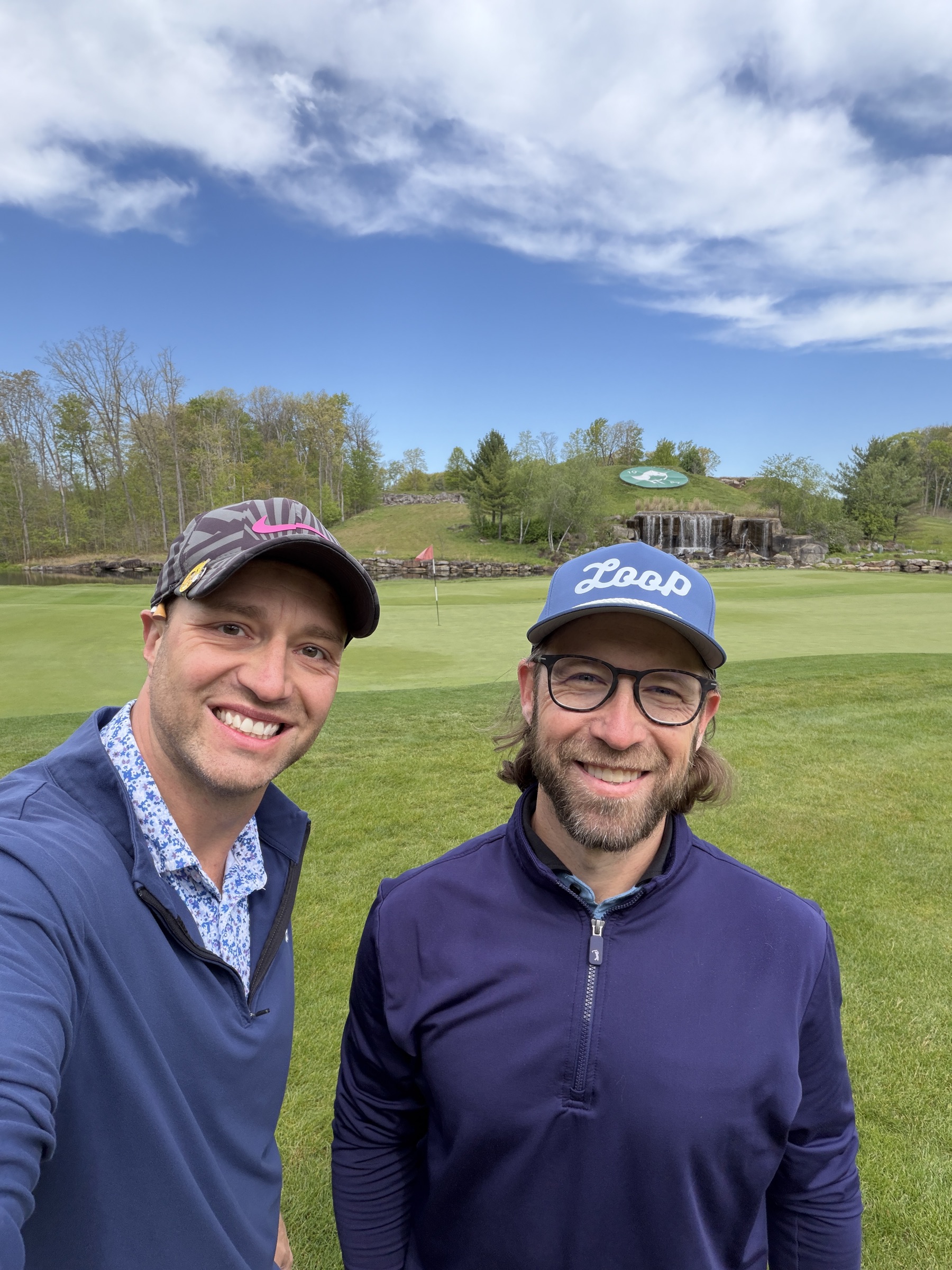 Somewhere mid-round. The stacked-stone bulkhead behind us is pure Pete Dye — every water carry on this property gets the same treatment.
What’s Next: Shepherd’s Rock
I’m planning to get back to Nemacolin later this summer to play Shepherd’s Rock, the resort’s second Dye design, which opened in 2017.
I actually played it once, right after it opened. The course wasn’t grown in yet. And I wasn’t really a golfer yet — not in the way I’d think of myself now. The 5-by-50 project hadn’t started. I didn’t know what I didn’t know. I walked the routing without really seeing it.
I’m curious to see how both of us have grown.
That’s what good golf does, I think. It keeps the record. The course is the same place it was the last time I was there, but it’ll look completely different to me now, because I’m a different player with different eyes. And in a few more years, I’ll come back and it’ll look different again.
The round I played today — the drive for my dad, the eagle on 5, the fight on the back nine — that one’s going in the book. The next one’s already waiting.
See the full trip: Mystic Rock at Nemacolin. May 11, 2026 — Par 72 — White Tees — 71.4 / 135 — 38 out + 46 in = 84 gross, 67 net.